
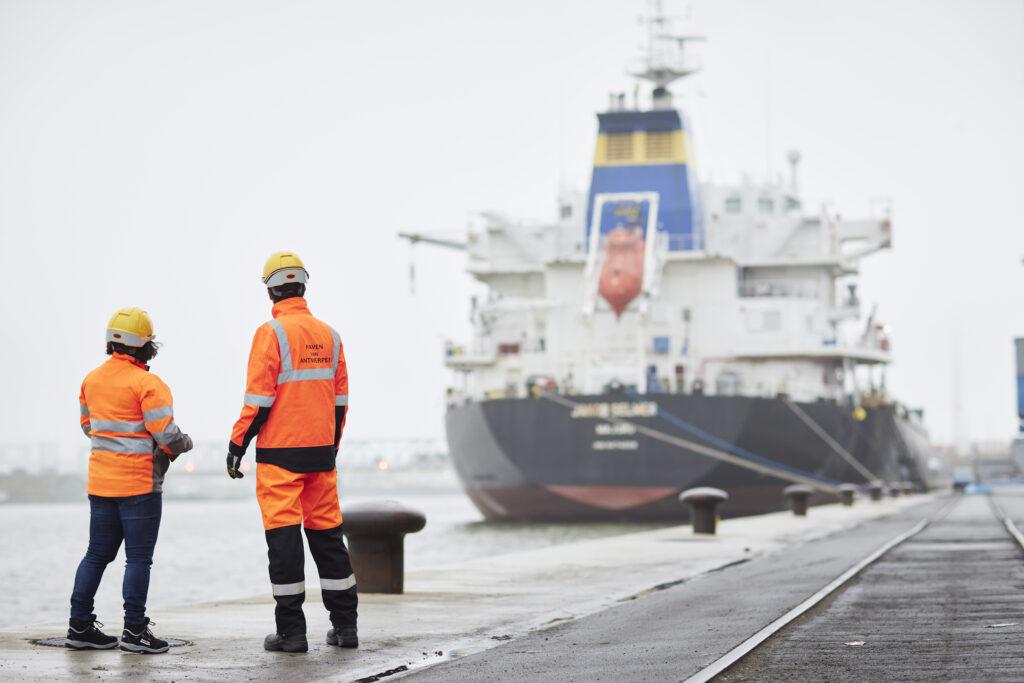
Covering an area of 12,068 hectares, employing more than 150,000 people, and serving 300 scheduled services to over 800 destinations worldwide, the Port of Antwerp-Bruges is the second-largest port in Europe. It comprises a highly complex ecosystem of terminals, companies, and logistics operators, alongside a growing number of digital stakeholders who collectively safeguard this unique working environment. Close cooperation between these parties is essential in the fight against organised – including drug-related – crime.
With the integration between the FPS Mobility and Transport’s AIGIS platform and Alfapass systems, another important step is being taken to strengthen port security. From now on, every Alfapass identity is automatically deactivated as soon as it is linked to a port ban.
Central data source for port bans
In early 2025, the FPS Mobility and Transport launched the AIGIS platform. The system was develeoped under the leadership of the Directorate-General of Shipping, with technical support from Cronos. The objective is clear: to centralise judicial port bans and make them available in real time to relevant authorities and authorised organisations responsible for identifying and authenticating port workers, as well as managing access to port facilities.
AIGIS enables port bans to be enforced in a uniform, secure and privacy-compliant manner. Once an investigating judge imposes a ban, it is registered on the platform and becomes immediately available for consultation and verification. AIGIS thus contributes to a more efficient and coordinated security of Belgian ports.
Automatic blocking following a port ban decision
Alfapass is currently the first organisation in the sector to achieve direct system integration with the AIGIS platform. Through this integration, Alfapass screens all identities for port bans. If a person holding a valid Alfapass Smartcard is subject to a port ban, the smartcard is immediately blocked. As a result, the individual can no longer successfully identify themselves at port terminals, and access to port facilities is revoked automatically, without any manual intervention.
Alfapass has completed all required procedures to connect to the AIGIS platform via official channels. The integration is now fully operational – a first within the Belgian port environment.
In a next phase, Prean will also support checks to determine whether registered visitors are subject to a port ban.
“If a person holding a valid Alfapass Smartcard is subject to a port ban, the smartcard is immediately blocked. As a result, the individual can no longer successfully identify themselves at port terminals.”
A pioneering step towards secure and efficient access
With this innovation, we further reinforce our position as a leading provider of digital identification and authentication solutions within the port sector. Automated control not only reduces the risk of human error but also ensures that judicial decisions take immediate and automatic effect at port access points.
Where the “Antwerp Port Area/ Brugge-Zeebrugge Port Area” signs mark the physical boundary, this digital link ensures that the same boundary is effectively and consistently enforced in practice. And we are proud of that.
What does this mean for …
- Terminals: Thanks to the integration, judicial port bans are applied consistently and automatically within existing terminal processes. Terminals no longer need to carry out additional checks or interpretations: the identity status is always current and applied uniformly.
- Companies issuing the Alfapass Smartcard to their employees: Court decisions are now translated into practice in an objective and automated manner. Employers no longer need to play a role in assessing or following up on port bans.
- Partners and integrators: The cooperation between AIGIS and Alfapass provides a single, consistent and reliable identity status on which partners and integrators can rely. This removes uncertainty and reduces the need for exception handling across connected systems.