
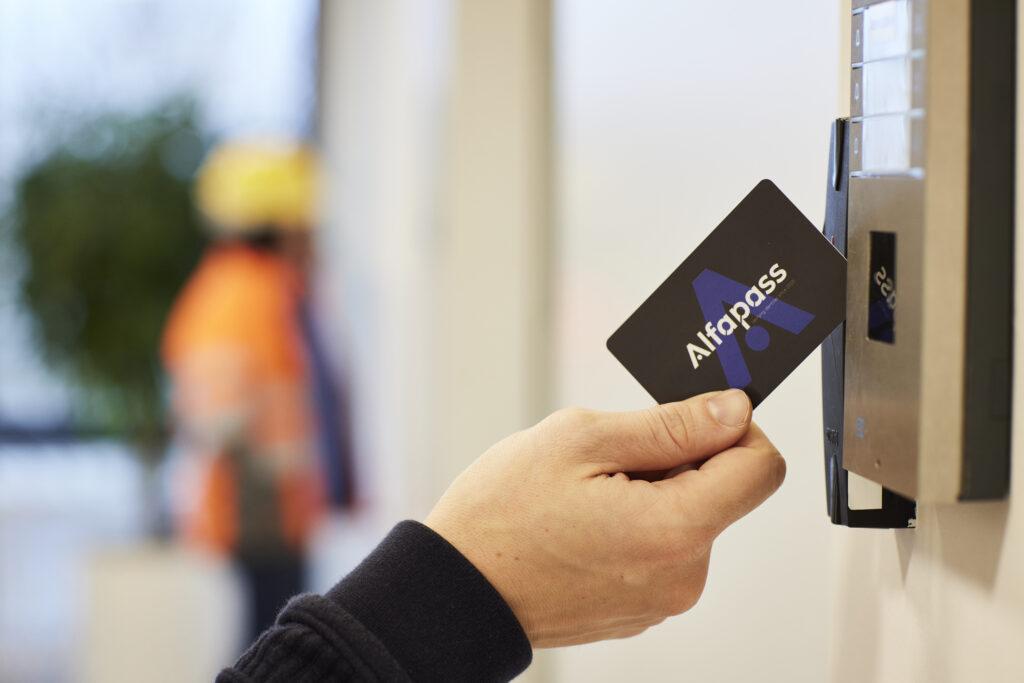
Digital identification and authentication are evolving rapidly. Across ports, logistics and industrial environments, an increasing number of solutions are emerging that promise greater speed, efficiency, and security. In this context, the physical smartcard is sometimes portrayed as outdated and less secure, partly because it can be shared between users.
But is this criticism justified? In this article, we examine common concerns about the physical Alfapass Smartcard and place them in the proper context.
Can a smartcard be shared?
It is true that an Alfapass Smartcard can be shared … just like an identity card. However, anyone who misuses a smartcard – or allows it to be misused – may be held liable for the resulting consequences.
The same reasoning applies to any solution that relies on a single authentication factor, whether that factor is a smartphone or a smartcard. This is exactly why Alfapass uses multi-factor verification. The smartcard does not have to stand alone; in critical infrastructures, it is in fact recommended to combine it with one or more factors, such as:
- something the user has (the smartcard)
- something the user is (biometric data)
This combination makes sharing pointless. Without a successful biometric match, an Alfapass Smartcard is simply useless to anyone attempting to misuse it. Furthermore, cryptographic keys are securely stored in tamper-resistant hardware, making copying impossible.
Our approach to data protection is equally robust and carefully designed. Biometric data are not stored as images, but as encrypted templates held directly on the user’s smartcard or mobile device, in line with the template-on-card or template-on-phone principle. There is no central biometric database. This privacy-by-design model complies with the strictest European requirements and aligns with ISO 27001 and 27701 certifications.
“Furthermore, cryptographic keys are securely stored in tamper-resistant hardware, making copying impossible.”
Is physical verification still necessary?
A valid question. Digital identification can be fast, user-friendly, and scalable when implemented correctly. However, in critical environments, speed alone is never the primary criterion.
At Alfapass, security starts with a physically verified identity. Every smartcard is issued only after a rigorous identity verification process, including:
- verification of the applicant’s official identity document for authenticity and validity, performed both digitally and manually by trained personnel.
- visual confirmation that the applicant matches the photograph on the presented identity document, again carried out both digitally and manually.
- secure capture of biometric characteristics, currently a fingerprint. This is a specialist process that requires expertise and strict controls. It is continuously reviewed to support the future integration of additional biometric modalities.
This one-time verification step establishes a trusted identity that can be relied upon for years of secure identification and authentication.
In ports and other high-security environments, the real question is therefore not “Can we do it faster?” but “How do we do it securely, efficiently and with due diligence?”
Why isn’t everything digital already?
Digitalisation is the future; there is no doubt about that. Demand for app-based digital identification and authentication solutions is increasing, particularly among smaller organisations and in less critical environments that primarily deal with one-off visitors.
Alfapass is not ignoring this development; on the contrary, we are responding to it. We will soon introduce a new digital identification solution. Further details will follow.
Alfapass as a pioneer
For more than 21 years, Alfapass has been the pioneer in identification and authentication solutions at the highest Level of Assurance (LoA3). That experience makes the Alfapass Smartcard a trusted foundation for organisations operating in critical environments, such as ports.
While our technology continues to evolve through new applications and integrations, it is always built on the same core principle: certainty about an individual’s identity before they present themselves on site.
Would you like to know how Alfapass combines identification and authentication solutions with digital flexibility? Contact us.